

Comment
L-Leucine Enriched Essential Amino Acids (EAAs)
Pharmaceutical Grade (Pure)
Available through your Activ8Health Practitioner
- Exercise is pointless unless you provide muscle with the building blocks to grow
 Research has shown only the EAAs are needed for protein synthesis after exercise1. No carbs were needed and the non-essential amino acids (NEAAs) were not needed for protein synthesis to occur after exercise1. Some studies have shown that adding carbohydrate can enhance protein synthesis2 , however, this is at a cost of adding calories.
- L-Leucine is a critical amino acid for mTOR stimulation the driver of protein synthesis after exercise. Just 4 scoops of the Activ8Health Leucine-enriched EAA Blend will provide 3g of L-Leucine that maximises protein synthesis
- Exercise can be harmful without providing the building blocks for muscle growth as the exercised muscle needs additional resources to grow and repair. To get these resources like amino acids your body will ‘rob’ Peter to pay Paul i.e. the body will raid tissues like tendons, ligaments, organs and bone through the Triage Mechanism proposed by Professor Bruce Ames

Warm-Up
 A walk with a weighted vest first is a good idea to warm up
- Push-ups or hanging from a door beam (see Home Equipment) for a stretch
- Simple jumping jacks or just jumps to warm up on a rainy day will be fine
- Keep the weighted vest on when doing your home exercises for added load
Finish off your sets with a SUPER-SLOW set
- It is suggested you start off with a slow count to 10 for both the concentric move or eccentric move
- This count can be stretched out as you progress
- What are you aiming for with Super Slow? It is to feel a burn or muscle failure at the end of that count which will vary for individuals and with fitness levels. Progress slowly. Use a 5 count concentric and eccentric move if you have to when you begin
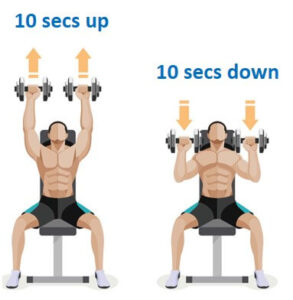
- This principle can apply to all exercises
- It ensures that the eccentric movement is maximised
- It takes away all momentum
- It provides increased Time Under Tension (TUT)
- It increases Metabolic Stress with Super Slow Exercises especially if you can lengthen the two concentric and eccentric movements
- 50% increased strength in men and women and inceased muscle mass7.
The 3 principles of muscle hypertrophy (growth)6
- Mechanical Tension
i. Increasing load gradually
ii. Concentrating on Eccentric Contractions of a movement
iii. Time Under Tension (TUT) – the amount of time the muscle is exposed to a load and SUPER-SLOW movements will significantly increase TUT - Muscle Damage – This will occur as a result of the load and reps being used and this is important to stimulate satellite cells (muscle stem cells) to mobilise and cause repair and growth. The Eccentric (stretching) movements cause more damage and hence more repair and growth.
- Metabolic Stress – This is the accumulation of metabolites such as lactate due to anaerobic (without oxygen) muscle stress. This happens towards muscle failure (exhaustion) where the Type-IIX muscle fibres kick-in. Advanced training techniques use occlusion training with bands but this needs to be approved by your doctor and best to see an Exercise Physiologist first before commencing this training. To be avoided by anyone who has vascular issues. The safest way to build up metabolic stress is SUPER-SLOW exercises
Do resistance exercises to failure
- This simply means exercising with weights, bands or using body weight until you just can’t do another repetition.
Rest periods after exercise
(The strongest Type-IIX muscle fibre fatigue period determines this need for rest)
1. Beginners – Exercise only every second day. Rest is critical to allow an increase in muscle mass as repair and growth can only occur in rest periods.
2. Type-IIX Muscle Fibres – These are the strongest muscle fibres in the human body and have the greates potential to grow. When you take an exercise to exhaustion you work your way from Type-1 → Intermediates → Type-IIX muscle fibres. These Type-IIX once engaged will not become activated again for 4 to 10 days or even more3, 4. This is essentially about dietary energy conservation as the Type-IIx muscle fibres are energy guzzlers when activated and dietary energy through human evolution has been difficult to obtain so this is an energy-conservation tactic.
3. Split Routines – Because it takes time for the Type-IIX to recover, you should never work the same muscle group two days in a row. Ideally, do upper body work one day, then lower body work the next day or day after and allow 1 day rest and start again. Rest and recover is vital to muscle growth along with optimal nutrition.
For beginners we will concentrate on the
Big-5 Exercises
- The Big-5 group of exercises can work the whole body with just 5 exercises3.
- The Big-5 can be done with body weight exercises or home gym exercises
- The Big-5 can also be done using Free Weights, Cable or Machines
- Beginners should always start off with body-weight exercises or free weights and try to use compound moves where multiple muscles and joints are used in just one movement
For advanced training we will concentrate on the
Big-5 Exercises (Foundation)
+
Advanced Techniques
+
Advanced Nutrition and Supplementation
There are many advanced training concepts that will be mentioned here but never used unless you have consulted with your doctor and an Exercise Physiologist (EP) first!
Without optimal nutrient intake, exercise can be harmful to the body as described above.
For muscle hypertrophy the critical factors are:
- Ergogenic aids such as HMB (b-Hydroxy b-methylbutyrate) a metabolite of the critical essential amino acid L-Leucine. This provides both an anabolic (muscle building) and anti-catabolic (stops muscle breakdown).
- HMB used along with the EAAs + L-Citrulline will provide not only the building blocks for protein synthesis but the anabolic stimulus for adding on lean muscle mass and prevent excessive muscle breakdown (catabolism) with exercise.
- Creatine for high intensity exercise, recovery and ATP production – Adults have around 80 g – 130 g of creatine in their bodies mainly in the form of phosphocreatine. The phosphocreatine is a phosphate donor regenerating ADP produced by the energy-rich ATP so that energy levels are restored rapidly. Derived mainly from animal meats something you just don’t want for a variety of known medical impacts, the consumption of 3 g to 5 g per day is all that is required to maintain the level of this important compound. No loading is required. Best taken in the morning or before exercise. Helps age-related loss of muscle mass in older adults (sarcopenia)
Know your ‘Eccentric’ muscle moves
- The eccentric (stretching) part of any resistance exercise is the most important
- Spend more time on this eccentric stretching motion as this will cause more microscopic muscle damage which is important for growth of muscle
Here are the eccentric movements for the Big-5 exercises opposite
Exercise
Eccentric Component
Gym
Home
Chest Press
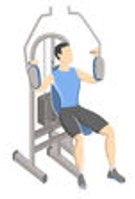
Concentric = Squeezing the arms together
Eccentric = Arms moving away, stretching the chest
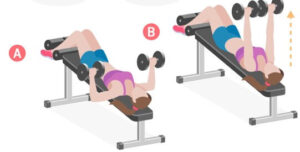
Concentric = Squeezing the arms upwards
Eccentric = Arms coming back down
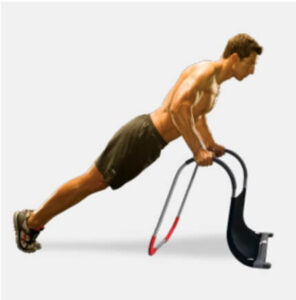
Perfect Fitness Chest Dip
Concentric = Pushing away from the handles
Eccentric = Coming down towards the handles
Leg Press Squats
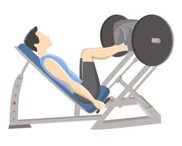
Concentric = The legs pushing away from you
Eccentric = The weight coming towards you
The Squat
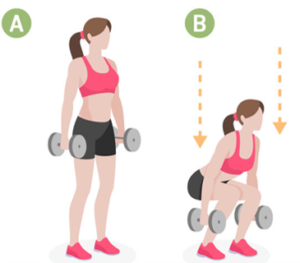
Concentric = The moving upwards phase (A)
Eccentric = The moving down phase (B)
Seated Row
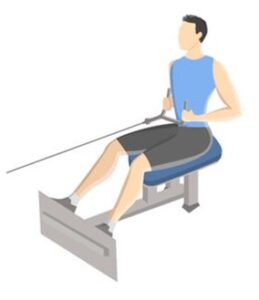
Concentric = Pulling the arms towards you
Eccentric = The arms moving away from you
One arm dumbbell row
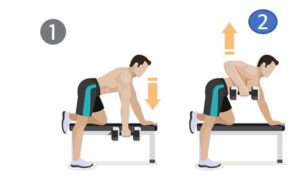
Concentric = Pulling the arm upwards (2)
Eccentric = Letting the arm fall back down (1)
Door hang
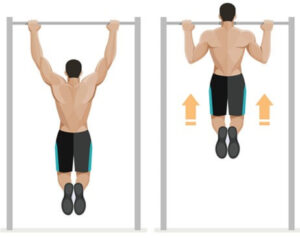
Concentric = Moving upwards
Eccentric = Coming back down
Overhead Press
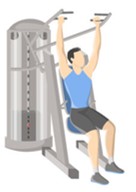
Concentric = Pushing upwards
Eccentric = The arms coming down
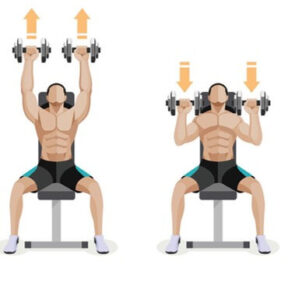
Concentric = Pushing upwards
Eccentric = The arms coming down
Pulldown
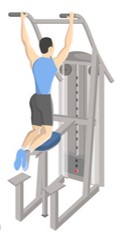
Concentric = Pulling the arms down
Eccentric = The arms moving back up
The Renegade Row
Whether you do this exercises on the floor with pushups inbetween or as above the following applies:
Concentric = Pulling the arms upwards
Eccentric = The arms moving back down
References:
- Børsheim, E., Tipton, K.D., Wolf, S.E. and Wolfe, R.R., 2002. Essential amino acids and muscle protein recovery from resistance exercise. American Journal of Physiology-Endocrinology And Metabolism.
- Dreyer, H.C., Drummond, M.J., Pennings, B., Fujita, S., Glynn, E.L., Chinkes, D.L., Dhanani, S., Volpi, E. and Rasmussen, B.B., 2008. Leucine-enriched essential amino acid and carbohydrate ingestion following resistance exercise enhances mTOR signaling and protein synthesis in human muscle. American Journal of Physiology-Endocrinology And Metabolism, 294(2), pp.E392-E400.
- Little, J. and D. McGuff (2009). Body by Science: A Research-Based Program for Strength Training, Body Building, And Complete Fitness in 12 Minutes a Week, McGraw Hill Professional.
- Ide, B.N., Leme, T.C., Lopes, C.R., Moreira, A., Dechechi, C.J., Sarraipa, M.F., Da Mota, G.R., Brenzikofer, R. and Macedo, D.V., 2011. Time course of strength and power recovery after resistance training with different movement velocities. The Journal of Strength & Conditioning Research, 25(7), pp.2025-2033.
- Ispirlidis, I, Fatouros, IG, Jamurtas, AZ, Nikolaidis, MG, Michailidis, I, Douroudos, I, Margonis, K, Chatzinikolaou, A, Kalistratos, E, Katrabasas, I, Alexiou, V, and Taxildaris, K. Time-course of changes in inflammatory and performance responses following a soccer game. Clin J Sport Med 18: 423-431, 2008.
- Schoenfeld, B.J., 2010. The mechanisms of muscle hypertrophy and their application to resistance training. The Journal of Strength & Conditioning Research, 24(10), pp.2857-2872.
- Westcott, W.L., Winett, R.A., Anderson, E.S. and Wojcik, J.R., 2001. Effects of regular and slow speed resistance training on muscle strength. Journal of sports medicine and physical fitness, 41(2), p.154.
